
Every concert guitarist knows the feeling. You play a guitar in a shop or a workshop, it sounds adequate — controlled, perhaps a little dry. You bring it onto a stage, play the first chord, and something unlocks. The sound fills the room in a way that felt impossible twenty minutes earlier.
The guitar hasn’t changed. The room has.
Understanding why this happens is not just an academic exercise. For a luthier, it changes how you evaluate your work, what you listen for when tap-tuning, and — crucially — what you optimise for when you know the instrument is destined for the concert hall rather than the living room. Projection is not a fixed property. It is a relationship between the instrument, the space, and the listener.
What projection actually means
The word is used loosely. Sometimes it means loudness, sometimes presence, sometimes something harder to define — the sense that a guitar is “speaking” to the back of the room. These are related but distinct.
Loudness is straightforward: the total acoustic power radiated by the instrument. But loudness alone does not explain why some guitars carry and others disappear. A guitar can be loud up close and still vanish at thirty metres.
Projection is better understood as the efficiency with which the instrument radiates energy in the upper midrange and high frequencies — roughly between 800 Hz and 4 kHz. This is where the ear is most sensitive, and where clarity survives distance and reverberation.
Presence — or carrying power — is strongly linked to the attack transient. A clean, fast onset gives the auditory system something stable to lock onto before the room begins to smear the sound. A slightly lean instrument with a sharp attack can project better than a warmer, fuller one with a slower response.
Projection is therefore not just about how much sound is produced, but where it is placed in the spectrum and how it unfolds in time.
The room as a second instrument
Sound does not travel directly from guitar to listener. It reflects, scatters, and interferes with itself. What we hear is the sum of:
- the direct sound
- early reflections (within ~80 ms)
- the reverberant field
The balance between these depends on the room.
A key concept is the critical distance — the point where direct and reverberant energy are equal. In many concert halls, listeners move beyond this distance within the first rows. From that point on, the room dominates perception.
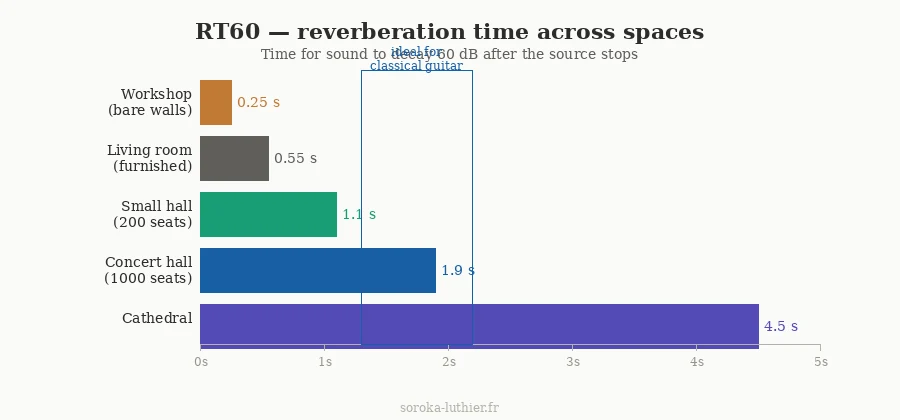
The most familiar parameter is RT60 — the time required for sound to decay by 60 dB. A workshop may sit around 0.2–0.4 seconds. A concert hall typically lies between 1.5 and 2 seconds. A cathedral can exceed 6 seconds.
But RT60 alone does not define a space. Clarity and early decay are equally important. A good hall for guitar balances sustain and articulation: long enough to enrich the sound, short enough to preserve definition.
Room modes and the unreliable workshop
Small rooms impose their own acoustic signature. Their dimensions create standing waves — room modes — that exaggerate some frequencies and cancel others.
Below roughly 200 Hz, these effects dominate perception. A guitar may seem rich in bass simply because it is exciting a room resonance. Move a few metres, and that bass may disappear.
The workshop is the worst possible place to evaluate the full sonic potential of a guitar. It is also, unavoidably, where every lutherie decision gets made.
For the luthier, this creates a paradox: the workshop is where decisions are made, yet it is the least reliable place to judge low-frequency response.
Directivity: the geometry of sound
A guitar does not radiate evenly in all directions.
- Low frequencies are nearly omnidirectional
- Mid frequencies begin to favour the front
- High frequencies project in a forward beam
This has a critical consequence: the player and the audience do not hear the same instrument.
The guitarist, positioned behind the soundboard, hears a bass-heavy image. The audience receives the forward-projected high-frequency content that defines clarity and projection.
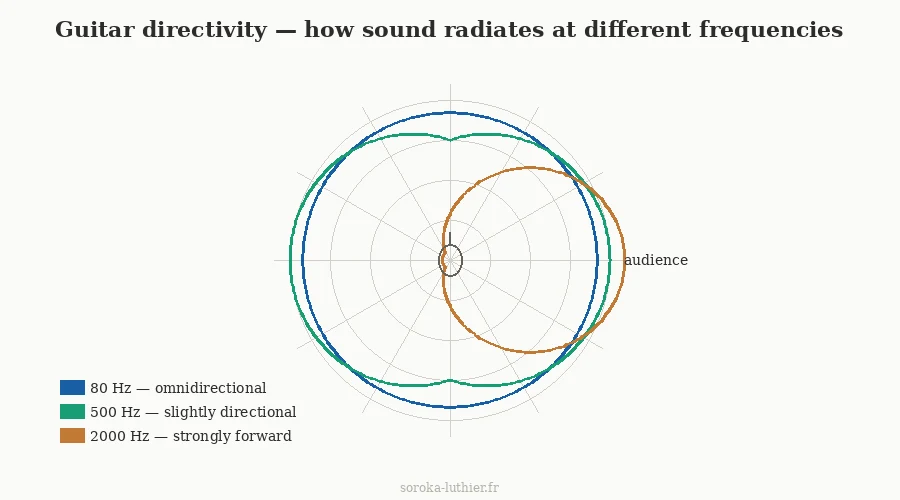
The back plate also contributes significantly, particularly in the low and mid frequencies, often in a more diffuse pattern. Together, top and back create a complex radiation field that varies strongly with position in the room.
A great concert guitar is not only powerful on-axis, but maintains a balanced response off-axis, allowing it to fill the room evenly.
The singer’s formant — and its limits
Opera singers project not by being louder, but by concentrating energy in a narrow frequency band between roughly 2.5 and 3.5 kHz — the singer’s formant. This region aligns with peak auditory sensitivity and avoids masking by the orchestra.
The parallel with the guitar is real, but not exact.
Unlike the voice, the guitar cannot create a narrow, adjustable spectral peak. It is a passive system. What it can do is maintain a broad region of sustained energy in the upper partials — roughly between 2 and 4 kHz.
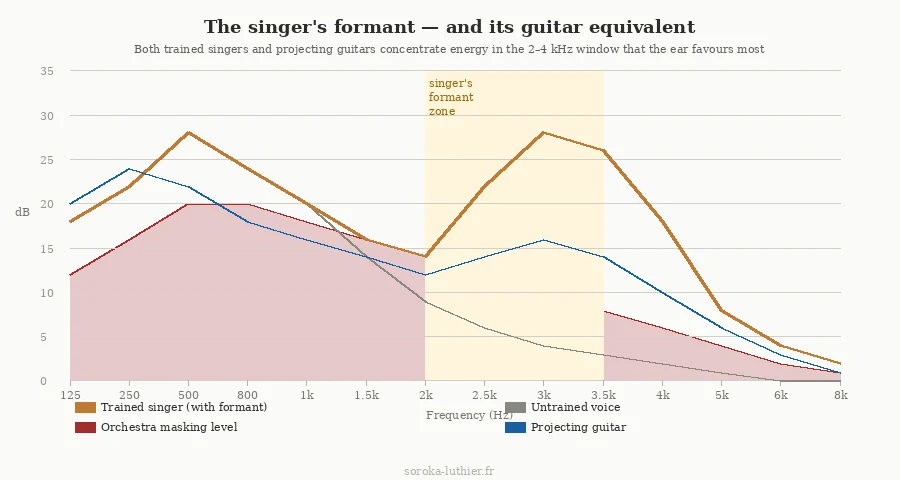
Projection, in both cases, is a matter of spectral placement and masking avoidance. Energy concentrated in crowded frequency regions is easily lost. Energy placed where the ear is sensitive and competition is low will carry.
Time, masking, and perception
Projection is not only spectral, but temporal.
The ear relies heavily on the first milliseconds of a note to extract pitch and articulation. A strong, well-defined transient resists the smearing effect of reverberation.
Masking also plays a role. Low-frequency energy can obscure higher frequencies, and dense reverberant fields can obscure weak signals. A projecting guitar avoids this by combining clear attack with sufficient energy in perceptually efficient frequency bands.
What the luthier controls
Projection emerges from a set of physical choices.
Top thickness and stiffness-to-mass ratio
A lighter top radiates more efficiently, but must retain enough stiffness to remain stable and controllable.
Bracing and modal distribution
Fan bracing supports a distribution of vibrational modes across the spectrum, rather than concentrating energy in a single resonance.
Air resonance (Helmholtz)
The air cavity resonance supports the low end and contributes to perceived fullness, but must be balanced against clarity.
Attack and transient response
A responsive structure transfers energy quickly to the air, producing a clean onset that survives in reverberant spaces.
Finish and damping
A thin finish — such as French polish — minimizes damping and preserves high-frequency radiation and attack clarity.
Evaluating projection honestly
The workshop is misleading, but not useless. Some practical strategies:
- listen from a distance
- play outdoors, where reflections disappear
- record from several metres away
These methods reduce the influence of the room and reveal more of the instrument itself.
Torres evaluated his guitars in the street outside his workshop. He was doing, intuitively, what acousticians now recommend: removing the room from the equation to hear the instrument alone.
What the player hears vs. what the audience hears
Because of directivity, the player systematically underestimates projection.
An instrument that feels warm, rich, and enveloping under the ear may lack the clarity needed to carry in a hall. Conversely, a guitar that feels controlled or even slightly restrained can project exceptionally well.
Instruments optimised for projection are not always the most gratifying to play in isolation.
The best judges of projection are not the player, and not the luthier — but the listeners in the room.
Building for the room you cannot hear
This is the central challenge of concert guitar making.
You build in a small room for a large one.
You listen from the worst possible position.
You optimise for a result you cannot directly perceive.
The tradition of classical lutherie — graduated tops, fan bracing, thin finishes — is the accumulated solution to this problem. Generations of makers have converged on designs that work in spaces they could not fully hear.
Understanding the acoustics does not replace that tradition. But it makes its logic visible.
Every decision — thickness, stiffness, geometry, finish — is a decision about how sound will travel through space, interact with a room, and arrive at a distant ear.
Every lutherie decision is an acoustic decision. The room is always present, even when you cannot hear it.